horz1

Monday, August 1, 2011

Late model Quad 303 (3rd unit)

I managed to purchase a Quad 303 with a IEC power socket and the large capacitors facing upwards. Such units were produced between 1980-1985.

Front
So far, have not tested the usability of the unit as I need to take out the Quad 33 to partner it. It does power up and the heatsink does warm up after left power for a few minutes.

Thus I decided to open up the unit to view it's state.

Before clean-up
After cleanup

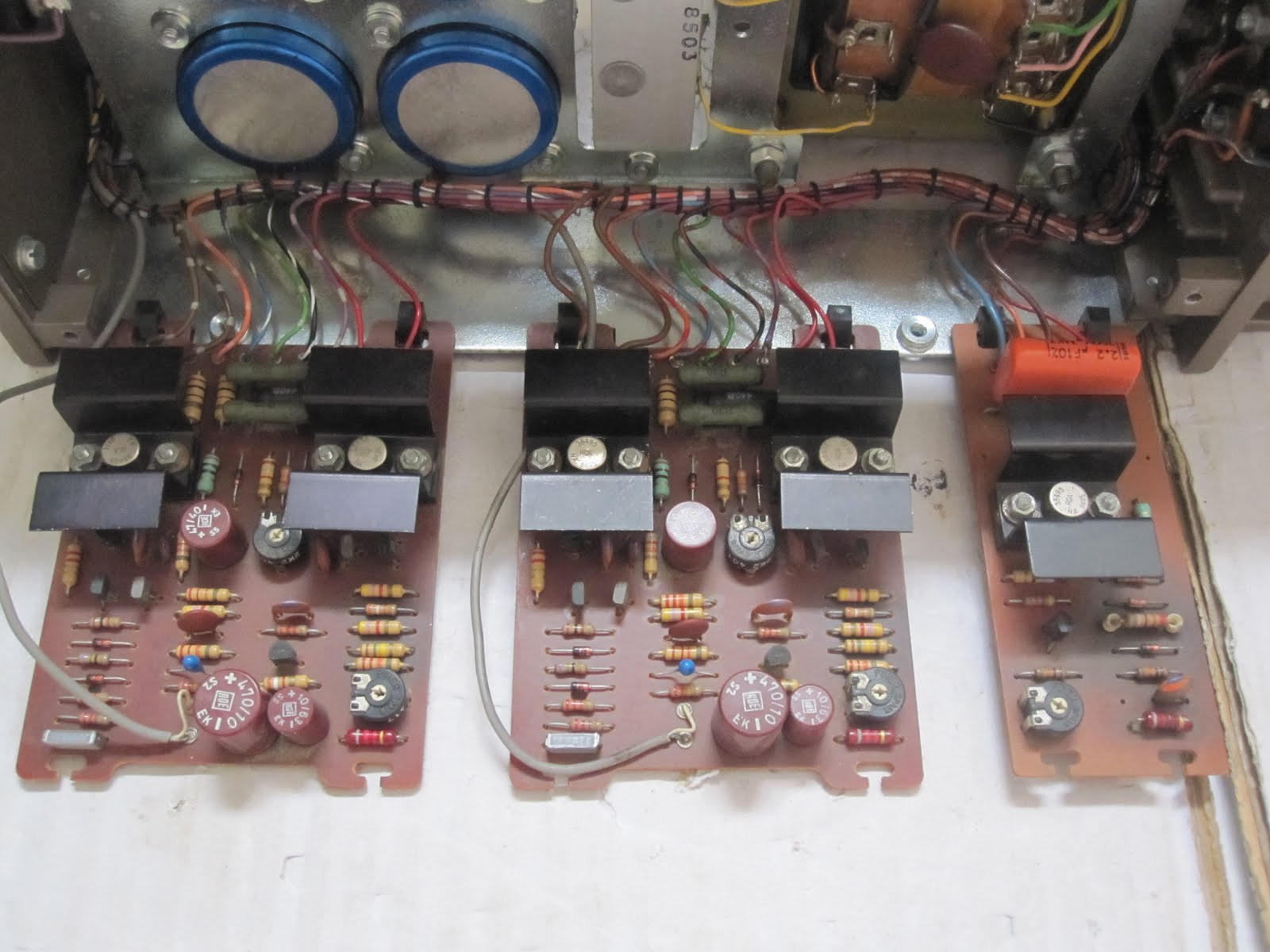
Before cleanup the layer of dust was about 2-3mm with a few feathers in the unit??? Had to remove the heatsinks to vacuum the boards. Rest of the unit was dusty enough.

Capacitor tops after vacuuming

When tested, the unit works fine without issues.

Friday, July 1, 2011

MicroMega DUO.BS

The MicroMega DUO.BS is a bit stream DAC in a compact package, with high-quality components all round.

It is dimensionally similar to my Mission DAC5 which uses the high-end Philips TDA1547 DAC. The DUO has an additional TOSLINK for input when compared to the DAC5. Both DAC(s) have a power-on switch with stand-by mode and a Phase-invert facility.

Front
Back
 The DUO.BS has better isolation of the transformer than the Mission DAC5 and uses available space to the maximum with 2 PCB(s) separated by a metal plate at the critical junctures.

Top from angle
Bottom from angle

Side view

How does the DUO.BS sound? When I did a A-B comparison between my X-10D and the DUO.BS - found them to surprising close in sonic quality (after warm-up with Phase Invert enabled). The DUO.BS is pleasure to listen to, after warm-up since I do not normally leave the unit on stand-by for extended periods when not in-use. You would not believe it is a bit-stream unit when listening to it!

Friday, June 3, 2011

Onix OA-20/2


Heard my 1st Onix amp in 1988, a OA-20. Should have bought it then...
Front
Slant view
More than 20 years later, chance upon a OA-20/2 in good working condition - not making the same mistake twice!

The Onix deserve it's well earn reputation of a great performing unit with grunt- an excellent example of British audio quality. Although rated at a lowly 30W RMS and weight a mere 4kg, it is no push over. The unit was hardly warm after running for a few hours with the volume at 7 o'clock. This was more than enough to drive my honeycombs to a decent volume in a room 30ftx20ft.

After warm-up, the Onix was revealing. The mid and HF was fluid when playing a CD of well recorded piano pieces. Bass could be better but acceptable, may consider a recap later on (since it has been over 20 years).
Top
Back

Component view from back
Little wonder these units are seldom available in the resale market. And are quickly snapped up when they became available!

Update - 30Jul2011

Finally decided to perform maintenance on the electrolytic capacitors in the power amplifier section, as the reproduction seem a little muddle on critical passages.

Upon closer inspection, notice the unit had been repaired before and a unknown brand of EC, "Sun" was used in the power rectifier section as well as one side of the power amplifier. Replaced the 100uf 10V with Panasonic FC and the original 4.7uf 50V with Panasonic ECA of equal values in the power amp section. Left the Sun EC in the power rectifier section as that should be adequate for the task. Using better quality EC and substituiting the pairs of EC in the power amp section provided the desired results. Source is the Sony CDP-333ESA which is now connected directly to the Onix without the tube buffer. The Onix is now driving my Mission 753 Freedom's via 1.5m of the original QED Silver Anniversary (with enough silver to cover most of the cable diameter).

Original amp section
Capacitors replaced from power amp section


Wednesday, June 1, 2011

Musical Fidelity X-10D

With the help of a friend, I finally managed to purchase a X10D.

Front
Rear

Since completing and tweaking the Lite LS-29 (clone of the X10), though it would be interesting to compare the stock X10D vs the tweaked LS-29 @ http://myoldvintagehifi.blogspot.com/2010/11/diy-tube-buffer.html

Stock PCB

The stock X10D uses Philips 6922 valves and produces a rich mid, nice high with a lean low after power-on. About 15-30min later, the bass becames fuller but I find the high can be just a tad brighter than an actual presentation should be. The X10D seem to have a slight roughness around the edge as well, particularly on voices. I was using a gold CD recording of a singer whom I heard during a live performance for comparison.

The LS-29 produces a more authoritative low and  "richer" high while retaining the rich mid of the X10D. The reproduction of the LS-29 was more natural.

Finally decided to recap using lessons learnt from the LS-29.

Recapped PCB

Upon power on there was a immediate bandwidth improvement, compared to the stock X10D which was more reserve in presentation. Voices were now more natural and realistic.

After a week or so, decided to change the 0.22uF Wima(s) to the older MKS-C 0.33uF in the audio section. Initially sounded overly bassey. After a couple of weeks, it's sounding very close to my Tubelog when performing A-B comparisons - with a bit more HF extension, maybe due to the use of silver mica's in th output stage.

Update - 18Aug2011
Finally swapped the Philips 6922 with the Russian 6N23P-EV. Reproduction clarity improved.

Tuesday, May 10, 2011

Sansui AU-217

The Sansui AU-217 is a 30W RMS per channel integrated amplifier from 1974 with a damping factor of 80. Total power consumption was 145W. Hence it packs quite a punch and was able to drive my Celestion SL6S with ease.

The stock unit sounded bass heavy with some high frequency roll-off. Details are semi 'veil-ed'. The stock AU-4400 had a more balance presentation but lack the punch of the AU-217. Personally I prefer the AU-4400 to the AU-217.

Front

Rear
The AU-217 was later recapped using silver mica's, OSCON, Panasonic FC and ECA, Wima and Rubycon. Generic EC were deployed in the non-audio sections.

Once recapped, the AU-217 can be a real shocker! Most of my visitors who heard it though it was atleast a 70-90W RMS per channel unit as it was able to make my Celestion SL6S sing with ease - packs a much bigger punch than the Arcam Alpha 8 power amp of 50W RMS per channel!

The quality of reproduction is heavily influence by the four 100uF 50V caps which are arranged in a 'L-shape' next to the large PSU caps. The other influential EC caps are the two 470uF 50V caps near the middle of the motherboard.

Please note there is a group of ceramic caps on the opposite side of the amp (away from the transformer) which influence the HF and should be replace with caution.

On my AU-217, replacing the large PSU caps resulted in extremely minor improvements.

In the past, the unit was only slightly warmish after running the unit for atleast 8-12hrs a day during the weekends.

Since you are unable to bypass the tone controls, it was necessary to replace all the non-EC capacitors there. I replaced them using Wima's of equivalent value and the effort was immediately rewarded with a fluid and transparent presentation - eventhough the tone controls were left at '0'.

Weakness includes limited connectivity to single pair of speakers,and, no speaker selector.

Otherwise quality sound at low power consumption!!!
View from rear after recapping

View from side after recapping


Saturday, April 9, 2011

Poly's normally replaced

Just realised I have never included the pix of the poly's I normally replace e.g from the pre-amp sections, since they were the source of the off-tune reproductions.

"Bad"on left, acceptable on right
The ones I found to be "bad" (aka off-tune) are those on the left in the above pix e.g green and creamish poly.

The yellow poly's on the right are acceptable but I find them to be "warmish" with slight degradation to the higher frequencies. I normally re-use these as by-pass(s) with good results.

Saturday, April 2, 2011

Sony CDP-333ESA

The remote capable 333ESA is a well build, 220~240V unit which weights about 12kg.

This CDP was recapped a while back after my friend puchased it on my behalf overseas. Hence apologies as I do not have the original pix of the internals.

CDP with Tubalog via TOS link
Rear
On the rear, the unit has a pair of fixed and another pair of variable outputs. Digital output is via TOS link only.

In stock form the unit portrait voices well in a warm conveying manner, unfortunately at the expense of background details. The background details were push back and well "veil-ed".

The previous owner installed a EMI filter but left it un-earth to the chasis. To rectify the issue, I placed a piece of old leather under the filter to isolate it from the chasis - see below.

Power filter with insulation

I recapped the audio section of the board only, leaving the power filter caps in-place since these seem to be in good condition and more than adequate for a CDP.

To remove the veil from the background details after initial recapping, I upsized 4x0.1uF green poly(s) in the audio path with 0.22uF Wima(s) aka the medium sized Wima's in the pix. In addition, I upsized the two capacitors in the top left (rear view) from 10uF to 22uF to "mellow-nise" the reproduction. Electrolytics were replaced using Panasonic ECA/FC, Nichicon Gold and Rubycon of the same values. Naturally the better components are placed in the audio section of the board.

Top view
View of motherboard from rear
The results?

A past visitor who was familiar with the Sony ES range of CDP(s) was pleasantly surprised at the performance and level of detail my 333ESA was delivering since he knew stock non-X7 models could not  deliver the level of detail and warmth he was hearing! He is correct as my X7ESD is superb in many pleasing ways - saving the best for a future post ...(bloody heavy too!!!)

Monday, March 28, 2011

Sound Dynamics THS-1000

This is my tiny dual-purpose 10in sub-woofer rated 100W RMS with peak of 400W. The unit has a solid built quality and weight over 10kg. It is my the only other non-British made (Canada) speaker in my collection.

The THS-1000 was originally purchased for my home theatre system which comprised of a Denon A1D, TU-1500 and DVD-2900.

Front
Without cover
Back

Saturday, March 19, 2011

Marantz PM-45

This little known Marantz was once What Hifi Stereo of the Year 1988 (http://www.dutchaudioclassics.nl/marantz_award_winning_products_list_1984-2003/)

Front
Rear
Rated at a reasonable 50W RMS per channel into 8ohms, it does pack quite a punch and is barely warm even after continously use for 12hrs! Details specs are available at http://www.dutchaudioclassics.nl/?strPage=Info&strBrand=Marantz&strType=Marantz_pm45&blnSefURL=true

The original unit sounds sweet with good details and respectable bass. However my unit required about an hour of running in before the sweetness appears. And there is the off-tone issue as per my original Luxman and Audiolab. Hence it was time to recap.

After I replaced the electrolytics on the power amplifier board, I proceeded to replace the dark green ploy caps in the pre-amp section (aka previously middle of the pix below)  with EPCOS (blue) poly of the same values. That did the job!

From top

Recapping was an easy process as all components are easily accessible with the base plate removed.

The PM-45 is a nicely balanced unit altogether!

Saturday, March 12, 2011

Quad FM-3 (2nd unit)

The FM-3 is a simplistic looking FM only tuner which accompanies the Quad 33 and 303.

Front
Even so do not be deceived by the simplistic looks. It's a very nice sounding FM tuner and easily betters my Sansui TU-D99X (rated at no#30 at FMTUNERINFO). I would dare say it cames pretty close to the performance of my Meridian 201 - a very nice tuner as well.

Rear view
Power is provided via Bulgin plug and output via the British traditional socket e.g 5-pin DIN. Aerial can be connected via a Quad 3-pin connector or the more popular 75ohm aerial socket.

There is an adjust for fine tuning but I hardly use it. It maybe useful when tuning for distant or weak stations.

Top

After recapping the PSU filters, I changed some of the poly(s) with Wima(s). There were minor improvements, most noticable are the headroom improvement and clearity of the reproduction.

Please note I did not perform any additional changes on my 1st FM3 (soon to came), except to replace the 3 electrolytic caps.  My 1st FM3 has gold-plated pins on the MPX IC whilst the 2nd does not.

Sunday, March 6, 2011

Quad Pro-63 (ESL)

Though largely based upon the successful ESL-63, the Quad Pro-63 was created according to Philips Recording Studio specifications in Europe.

Most noticable differences are the use of steel instead of aluminium for support and handles on sides. Power handling is about 100-150W. Each speaker weights about 16kg. I was not able to locate the sensitivity for the speaker on any documentation but estimate it to be about 78dB or79dB - losely based upon the volume dial to achieve approximate volume from my SL6S.

Side view

From rear


The Pro-63 are not easy speakers to drive. Long ago I owned a Pioneer A400X which was able to drive the SL6S effortlessly. However when I transferred the speaker cables from the SL6S to the PRO63, there was no sound when the volume was at 9 o'clock??? Initially I though either the PRO63 or the A400X had developed an issue. I decided to slowly turn the A400X volume until I could hear something. Music was finally audioble at about 2 o'clock!!!

The Quad ESL(s) are well-known for superb and realistic imaging but poor bass. I normally use the Sound Dynamics THS-1000 subwoofer (100W)  to accompany the Pro-63 (and SL6S).

My Pro-63 are placed on the non-Quad stands which were design with a gently tilt to project the image upward.

I was lucky enough to obtained the pair from a well-off gentleman who had several pairs of Pro-63 in his home. The serial number is 29xxx and estimated to be from about 1988.

Thursday, February 24, 2011

Sugden P51

Yes I finally located the P51 in the storeroom!!!

The P51 is the power amp which accompanies the C51 pre.

Weighing about 10kg, the unit is able to deliver 50W RMS per channel and had the innovative feature of being able to be converted into a mono-block with the flick of a switch (for the 60's).

The P51 is known to be able to drive extremely demanding loads and many often used them with ESL(s).

In addition, the C51-P51 pair was often the reference set for many reviewers in the late 60's and early 70's.

Front

Back

Top
Right side

Left side
The last time I fired up the C51 with P51, reproduction clearity was startling - when you consider the age of the unit.

Need to locate the special DIN cable which came with it ... one of the joys of having too many units and managing the misc cablings for them!!!

Wednesday, February 23, 2011

Speaker cables I am using


Please note I understand there are many opinions and preferences in this area. I am not implying in any manner or form, if any make or model of speaker cables is better than the other, or, even attempting to rate them. 

I am only advising this is what I am using to connect the various units in my collection of speakers and amps aka this is what works for me


The next question my visitors frequently ask after checking out my various speakers are (pix in Mission 753 link below) ... what speaker cables are you using? once they have heard my setup, and, noted the various well known speakers I have in my listening area.


The following is a close-up of the thin-nish speaker cables I am using.
Closeup of speaker cables from the Sansui AU-7900
You can see them deployed in the pix(s) for the Mission 753  at http://myoldvintagehifi.blogspot.com/2011/01/mission-753-freedom.html, Meridian A500  at http://myoldvintagehifi.blogspot.com/2011/02/meridian-a500.html and Sansui AU-7900 at http://myoldvintagehifi.blogspot.com/2011/01/sansui-au-7900.html

Any guesses? If someone gets it right, I will spill the beans and reveal how I acquire them. 

Been using these speaker cables since 2004 for my Celestion SL6s, Quad PRO63, Meridian A500 and Technics SB-X700. I have a large box of well known brands of speaker cables in my storeroom - been there in the storeroom since I started using the above cables. Only took out the QED Silver Anniversary for the Mission 753 recently - can't recall when was the last occassion I used it before this!

Sssshh to my visitors who know the answer ... please don't tell them yet !!!

Saturday, February 19, 2011

Meridian A500

My visitors often ask about my unbranded speakers (logo not visible from front) once they hear it. My usual response is  "... don't worry just enjoy the music".


View from sofa

Curiosity usually gets the best of them after about 5-10mins .  . . 
Angled view
Rear
Rear
Top

Frequent reactions upon eye-ing the well known logo include these for real?, how old are they?, where did you get them from?, and, don't remember this model?

The A500 was the last passive model speaker from Meridian e.g mid 90's. Judging from my visitor responses of the reproduction, one can easily imagine why the model is rarely available in the resale market.

Removing the sock (aka dust cover) reveals the two 6-inch units for mid and bass. Treble is provided by a horn loaded tweeter. Each speaker weights 25kg.

Without sock
Sock for speaker

Although rated at 90dB with maximum wattage of 100W, it is a surprisingly power hungry unit. I was using the Celestion SL6s (well known power hungry model) paired with a 100W subwoofer before switching to the A500. The SL6s were rated at 86dB and 120W. I expected the volume to increase after the swap. Received a most nasty shock as I had to turn the volume up a little more from the same setup, to obtain the volume as per the SL6s when using the A500!!!

From experience the A500 is at it's best when driven in a horizontal bi-amp mode. Bass is then superbly firm and sounds extremely realistic. High power amps are required to do so. Otherwise you will hear the polite bass, as per hifi reviews from the past. I previously used a pair of Arcam Alpha 8 power amps (50W RMS per channel; my mistake to use the newly recapped Sansui AU-5900 as pre-amp!!! Buyer wanted that as well)  for the task. Sold the Arcams as they were hardly used once I had my Sansui B-2101 and Sansui B-2102 power amps recapped since these were more capable (each rated at 200W RMS per channel).

Another unique feature is the method to re-sock the speaker. There are no pugs or pins to hold the sock in-place. Instead the grooves towards the front of the speaker are the holders. These grooves run the entire front parameter of the unit. Once you place the sock into them, you need to use a credit card (or similar plastic item) to push the sock firmly back into place.
Before "sock-ing"
"Sock-ing"
The base of the speaker has four spikes which are adjustable. My A500 was adjusted to be just slightly higher on the front than rear to permit better image projection nearby.

The original boxes for the A500 now store my SL6s.