horz1

Sunday, April 1, 2012

Sansui B-2101

Missed the amp after it last seen day light ... about 2 years ago!
Front view with meters on

Front view with meters off

The B-2101 is a 200W RMS per channel power amp with the X-Balanced technology. Basically a scaled-up version of the power amp section from the Sansui AU-G90X e.g 8 transistors per channel vs 8 transistors for both channels on the G90X.

My other Sansui power amp, the B-2102 is prety much the same as the B-2101, except the reservoir caps are smaller at 8,200uF instead of 10,000uF. Other non-audioable difference was the DISPLAY OFF on the B-2102 does not really switch off the display but disables the audio feed to the electronics. The B-2101 and B-2102 sound pretty close to the other.

I normally partner the B-2101 and/or B-2102 with the Sansui C-2102. There are slight differences between the C-2101 and C2102. The C-2101 has more capacitors on the Parametric EQ motherboard (LHS if looking from front).

I had recapped it a few years back as the unit was taking over an hour to sound proper. In addition, the caps the in the PSU board had leaked, other caps on the power amp boards looked like they could do with a replacement after many years of service. Used the following EC(s) - Nichicon and Rubycon on the PSU board; Panasonic FC and FM on the driver and power amp boards. Some ceramics and polys were replaced with Wima(s) on the power amp boards. All replaced caps are of original values.

From top

Top view without cover

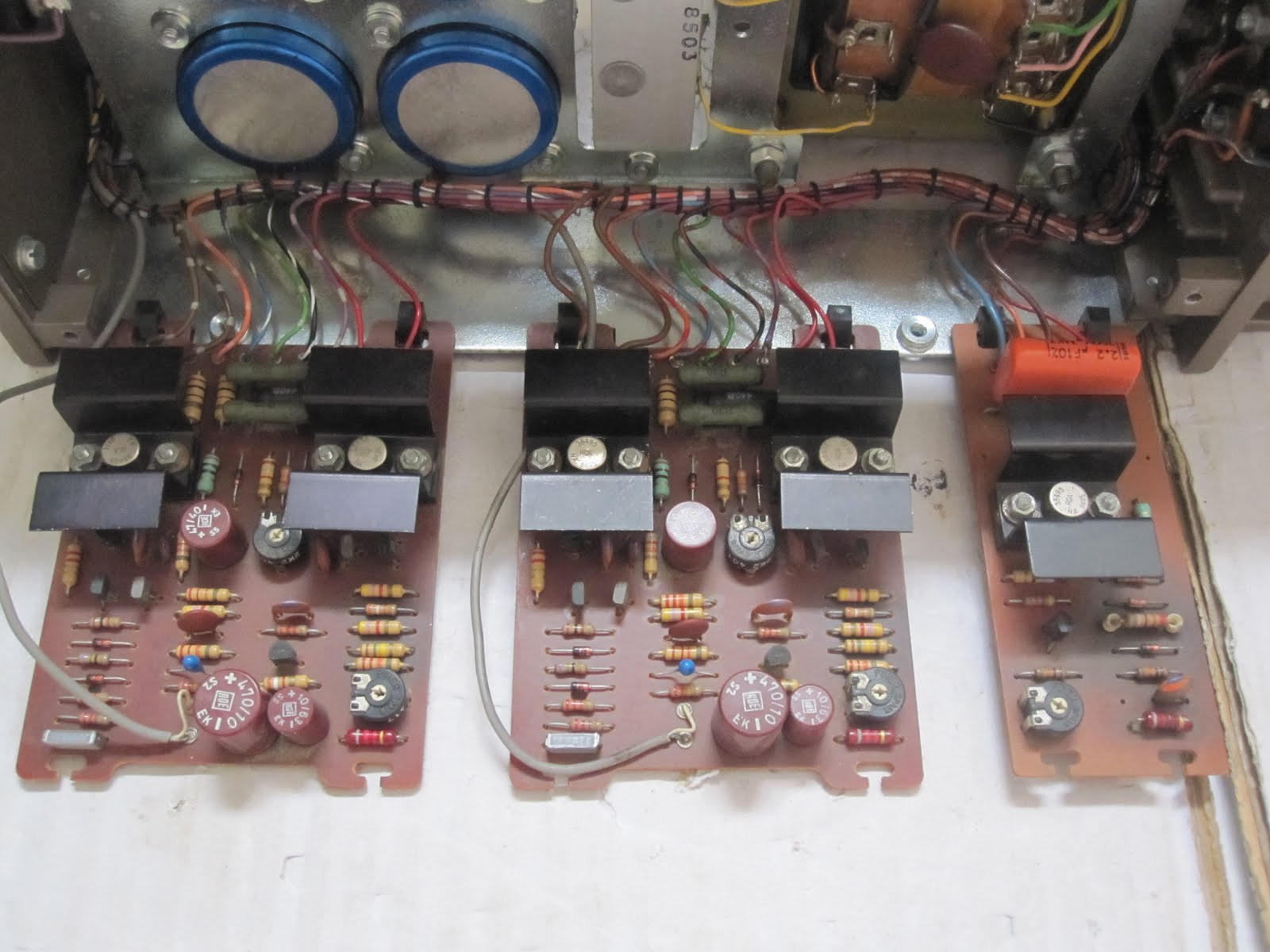
Close-up of one of the power amp sections

Close-up of one of the driver boards

In the past I had performed a test between the B-2101 vs the Meridian 557 in a all Meridian setup. The 557 excelled at vocals though the B-2101 has a wider dynamic range.

Uploaded the following brochure of the B-2101 as the information is scarce on the internet.


Can't wait to setup horizontal bi-amping with the B-2101 and B-2102 after the superb results with bi-amping the Quad 303(s)!!!

Now where did I put the B-2102 - was not in the storeroom where I was expecting it to be???

Wednesday, March 28, 2012

Brochure on Sansui X-Balanced System

Decided to upload pages from the brochure as information on the X-Balanced System seem to be scarce on the internet nowadays.

Part 1
Part 2

Friday, March 9, 2012

Meridian 201

Was searching for something in my store room when I came across the 201.

Front, in stand-by mode

Rear

A favourite among Meridian enthusiasts, the 201 cames in a handy compact package with remote capabilites. 

Like other 200-series units, it was designed to be left connected to the mains and goes into a Stand-by mode when turn off via the 209 (aka the flat brick of a remote which eats 9V batteries for breakfast!).


The 201 is a nice, natural sweet sounding pre-amp which can be matched with a variety of non-Meridian equipment. 

Only had the PSU section recapped since it has seen many years of service.

When they do appear on the resale market, normally goes pretty fast.

Saturday, February 11, 2012

Bi-amping with the Quad 303(s)

Finally had the time to bi-amp the Quad 303(s).

Researching the service manuals and inspecting the DIN socket on the 303 reveal the following pin configuration.

Front view with DIN pin numbering
From the manual


There are two popular bi-amping configurations - standard bi-amping (or horizontal bi-amping) and vertical bi-amping. Borrowed the handy illustrations below from the internet.


I decided to proceed with vertical bi-amping. Vertical bi-amping requires two amplifier of similar configuration (as close as possible). I cable the interconnect with output from the Quad 33 LEFT channel to the LEFT&RIGHT for one of my Quad 303. Likewise for the RIGHT channel using my other Quad 303.
Overview of bi-amp setup

View from top of the cabling

Side view
Cabling was completed using three Deltron 4-pin DIN plugs, recycled (normal) phone wire and my handy speaker cables. Normal phone wire??? Yes, many of my visitors were very surprised at its excellent quality (not reveal to them initially). They couldn't believe their ears till they listen for a while and wanted to know what cabling was deployed!!!!

Cost of the experiment was about $20 with the Deltron plugs accounted for most of the cost.

There's definately improvement in the presentation - the soundstage presence, vocals and instruments are much much better defined and realistic; so much so took some getting used to??? At low volumes, the sweet spot sounded like using a single 303 in stereo mode. When the volume was turned up, the sweet spot "grew". At the usual listening position, it was as if I was seated much closer to the speakers. Guess the 303's were having an easy time driving my Meridian A500 speakers (89dB)?

Actually sounds quite divine!!!

Highly recommended for Quad 303 enthusists who want more from their old faithful.

I used my 1st Quad 33 to drive the 303's.

FYI: One of my recent visitors actually inspected the 303's to make sure there were no valves in them!!!

Saturday, January 14, 2012

DIY portable fan unit for amplifier

Since I had the Sansui AU-9900A in the hall, decided to explore a DIY portable fan for the unit as it runs alarming hot.

Discovered there were two variaties of fans - AC and DC. DC type fans are those commonly found in your PC and tend to be less noisy but required an external transformer unit to function. AC fans run straight off the wall socket and usually more capable than their DC cousins but noiser as well.

My first experiment was using DC fans which were borrowed from my home desktop PC. These were quiet but several fans were required to provide effective cooling for the amp. The noise level for the fans were surprisingly low at just  above 40dB (via noise meter app on my iPhone)!!!
AC fan
Next experiment was to use an AC fan - noisy at about 80dB with the bare fan sitting on top of the amp. Placing the AC fan on a plastic platform was slightly better at just over 70dB.

My next attempt was much more successful. I used a ice-cream container (with foam) to house the AC fan within. Doing so reduce the noise level to just above 40dB!?! Noise from the AC fan was hardly noticable from 6 feet away. The amp was only slightly warm after 6 hours of continuous use.

Will update once I have time to experiment further.

Top view

Bottom view
DIY AC Fan pilot

Sunday, December 4, 2011

A.C Magnum IA-125 (***Updated#2***)

This is the newest edition to my collection - so new I had not even had a chance to power it up yet!

Front

Top view
Back


Internal


An acquintaince informed these units are quite collectable nowadays and had regretted selling his unit many years ago.

There seems to be little information on the net on the IA-125. Basic information is about 40W RMS per channel, 10kg and was made to sound like a valve amplifier.

Update - 6Feb2012

Did not connect the unit to my speakers as had some doubt on the direction to turn the volume knob. Removing the top cover requires a hex key of sorts for 7 screws - I made do with a medium Torx screw driver.

Testing the volume pot connectors with a multi-meter reveals volume is zero when the dot on the knob points noon. Increase volume by turning clockwise.

Powering up the unit after connecting the CD player and speakers - you get the normal THUD, typical of Brit amps without any speaker protection - as per other famous Brits e.g Naim NAIT, early Exposure(s),  etc.

This little amp has SPADES of drive and sounds great right after power-up!!! The IA-125 rewards when partner with high quality components. Reproduction is detailed, with clearity and the infamous British warmed. 

Am still marvel-ing at how musical the unit can be!!!

Tuesday, November 1, 2011

Sansui AU-G90X


Front, angled view

The AU-G90X amplifier is an old favourite. The matching tuner is the TU-D99X. The G90X is a X-Balanced integrated amplifier. Other X-Balanced units I have are the B-2101 and B-2102.

Sounds as good as ever, even after about 2 years in storage. Previously I had great difficulty convincing myself to put the unit back into storage. Took several months before I got around to it!

Bottom view, in storage box

Top

I had recapped the unit a few years ago as it took more than an hour before sounding right. When examined, all the EC(s) in the PSU board showed leaks. Other EC(s) in the pre and power amplifier section showed signs of usage over many years. Panasonic ECA/FC/FM, Rubycon, Vishay BC, OSCON, silver mica(s) and Wima(s) were used during the recapping. No replacement was performed on the tone control board, since these were hardly utilised.

The original plastic foam used for cushioning the buttons were so old they disintegrate upon touch! Hence I replaced them with similar sized equivalents. The resultant produces a nice cushioned feeling when depressing the buttons.

Top view, without cover


Close-up of power amp section


Close-up of  phono section, after internal separator removed

Apologies as I forgot to take a pix of the rear in my haste to get the beastie operational.

The current pix(s) does not show the pre-amp board as these are only visible once the face plate has been removed. The PSU board can be seen from the top but is mostly obscured by the mounting before the faceplate.

Will update the missing portions another day.

Found the following while searching the internet for reviews on the "not so common" G90X.

A Swedish Magazine begun 1983 to use "Anagraph" for displaying an amps behavior. When they 1986 checked AU-G11X and AU-G90X the comment was that (Translation) they never before got an anagraph so perfect as they got with AU-G90X. The only hint can be seen at 50kHz and 100W but this hint is the smallest we have seen. Output power at clipping is stated to be 150W at 8 ohms but we measured 170W across whole frequency range


Anagraph for the AU-G90X

Uploaded the following brochure of the G90X as the information is scarce on the internet.

Saturday, October 1, 2011

Blaupunkt P-60


A simplistic turntable, designed with the minimalist in-mind.

Front

The P60 is a belt drive auto-return turntable with option for 33 and 45 rpm records and includes an adapter for the the older 45rpm records. Since the P60 does not have any power on-off switches, the platter rotates upon power-on. There is no strobe light. The only other button is the STOP button which will cause the arm to return to it's resting place. There original arm has anti-skid with tracking adjustment. 

Original mat
Original stylus

Even so, the P60 was sonically pleasing. Sounds superb when playing any LP in good condition. The P-60 was well designed, so much so when I drop the dust cover after starting a track, you would not heard the dread loud thud. Does no favours for any poorly maintained records though...

I was listening to an old favourite - country music from the sound track of the movie Coast to Coast, starring Robert Blake and Dyan Cannon. Could hear all the details re-produced properly with no skipping, mis-tracking or the external influences when I was jumping up and down next to it (when it was place on the floor)!!! 

Not bad for a simple but well designed turntable from the early 1980's

Without mat
Bottom view

Internal view from bottom

Saturday, September 3, 2011

Meridian 602


The 602 is the dedicated CD transport from the 600 series and was part of the company's no expenses spared range of hifi components from the mid-80's. The 602 was design to use the Philips CDM-4/PRO lens.

The 600 series were constructed using anodised aluminum to ensure durability with minimum maintainence requirements. One unique characteristics of the 600 series was the deployment of twin blocks to separate power supply from control electronics, to minimise disruptions from power sources.

The 602 can be partner-ed with components from the 200's series and can be place into standby or operation mode remotely. Normally I would use the Philips Pronto programmable remote to control the 602 as it is less cumbersome than the original Meridian 209 (pix from internet as need to locate it in the store room; feels like a brick and eats 9V battery's for breakfast!!!).

The DAC which partners the 602 is the Meridian 606 which I had to perform maintained earlier on.
Stand-by mode

Rear
Tray extended

Play mode

The 602 can be partner with other DAC(s) for good results. In fact, I only discovered how good the 602 was when I partner-ed it with the Audiolab 8000DAC vs the Audiolab 8000CDM. After the shoot-out, I proceed with substituitions on the Audiolab 8000CDM.

Monday, August 1, 2011

Late model Quad 303 (3rd unit)

I managed to purchase a Quad 303 with a IEC power socket and the large capacitors facing upwards. Such units were produced between 1980-1985.

Front
So far, have not tested the usability of the unit as I need to take out the Quad 33 to partner it. It does power up and the heatsink does warm up after left power for a few minutes.

Thus I decided to open up the unit to view it's state.

Before clean-up
After cleanup

Before cleanup the layer of dust was about 2-3mm with a few feathers in the unit??? Had to remove the heatsinks to vacuum the boards. Rest of the unit was dusty enough.

Capacitor tops after vacuuming

When tested, the unit works fine without issues.